
Wendy@casenl-china.com +86-18924813070 +86-18033206107
English 

Author: Site Editor Publish Time: 2026-07-27 Origin: Site
Quick answer:
An embedded socket is a power outlet built flush into a surface—such as a desk, countertop, or floor—to deliver electricity and connectivity without exposed wiring or bulky hardware. These solutions now integrate USB charging, audio output, and wireless features, making them the preferred choice for residential, commercial, and hospitality design projects worldwide.
Clean desks. Clutter-free kitchens. Conference rooms where cables don't dominate the table. This is the standard modern designers and facility managers are chasing, and embedded sockets are one of the most practical tools helping them get there.
Traditional wall outlets served their purpose for decades, but they were never designed with today's multi-device environments in mind. A surface-mounted outlet on the far side of a room doesn't help a remote worker, a hotel guest, or a restaurant customer who needs to charge a phone mid-meal. The shift toward furniture-integrated and surface-mounted power solutions reflects a fundamental change in how people interact with their environments—and with the electrical infrastructure built into them.
This guide breaks down how embedded socket technology works, what variants are available, and how Casenl Electrical's product lineup helps designers and procurement teams source the right solution for any project.


A standard wall outlet sits inside a box mounted to the wall. It delivers power but offers no flexibility in placement and requires users to route cables across rooms. An embedded socket, by contrast, installs directly into a horizontal or vertical surface—a desk, a kitchen island, a conference table, or a floor panel—so that power is available exactly where it's needed.
This placement shift changes how spaces function. In an open-plan office, embedded desk sockets eliminate cable runs across the floor. In a hotel room, a bedside unit with USB ports and AC outlets keeps nightstands clear. In a kitchen, a countertop socket that retracts when not in use removes the hazard of exposed outlets near water.
The design discipline that drives embedded socket adoption is the same one behind minimalist architecture: fewer visible components, more intentional surfaces. Casenl Electrical, founded in Foshan, China in 2008, has spent over 15 years manufacturing switch and socket solutions for residential, commercial, and industrial environments—and embedded formats now represent one of the fastest-growing segments in their product catalog.
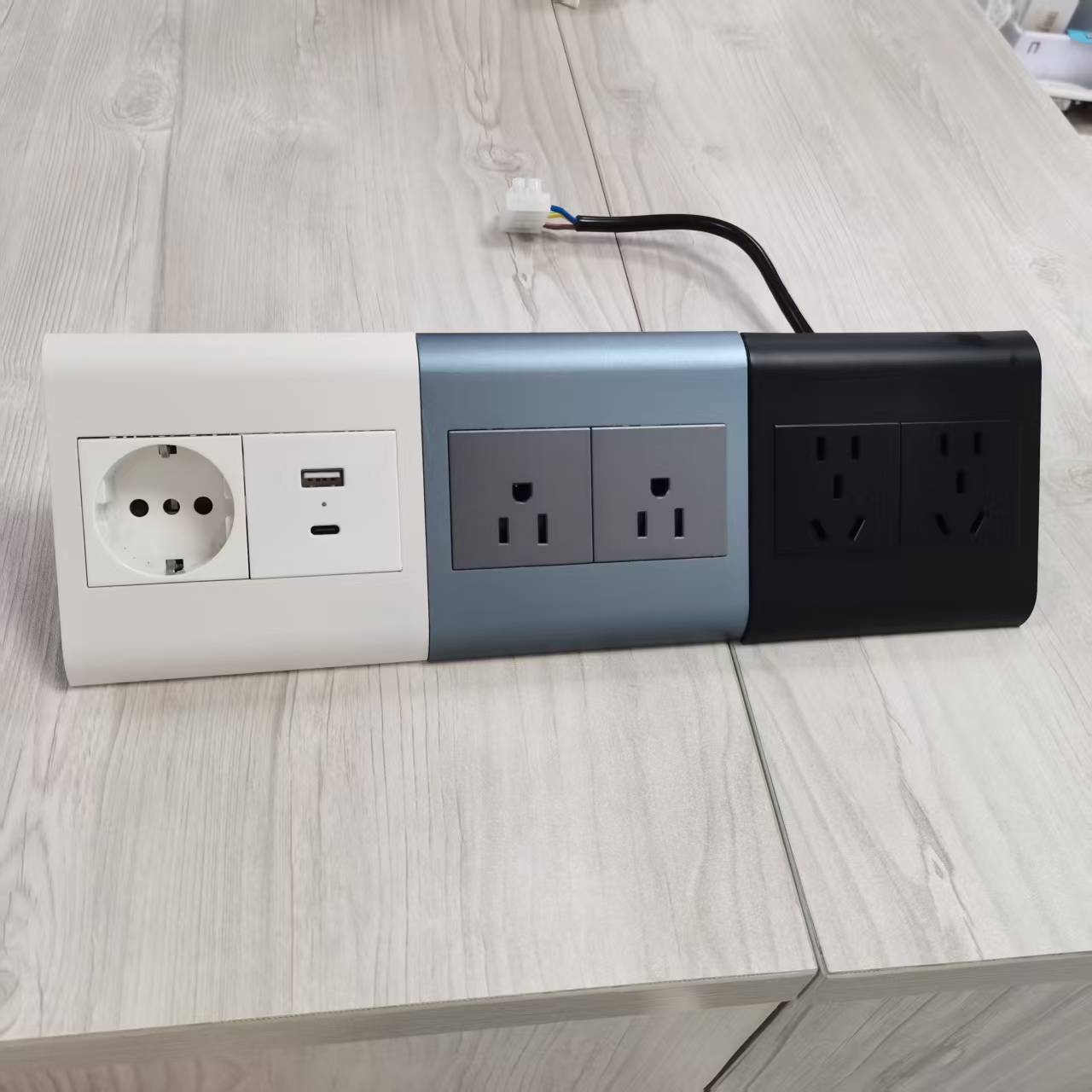

Not every embedded socket serves the same purpose. Below is a comparison of the most common configurations available on the market today.
Socket Type | Primary Use | Installation Surface | Key Feature |
|---|---|---|---|
Pop-up / Lifting Socket | Office desks, kitchen counters | Horizontal surfaces | Retracts flush when not in use |
Floor Socket | Open-plan offices, exhibition halls | Floor boxes | Weatherproof lid, high foot-traffic rated |
Desktop Inlay Socket | Conference tables, workstations | Desk cutout | Combines AC + USB in one unit |
Modular Panel Socket | Boardrooms, co-working spaces | Surface panel | Swappable inserts for different plug standards |
Round Embedded Socket | Furniture, cabinetry | Circular cutout | Compact design, ideal for limited surface areas |
Casenl manufactures several of these formats with CCC, CE, and FCC certifications, ensuring compliance across major international markets. Their ISO 9001-certified production process and five registered national patents reflect a consistent focus on quality and product differentiation.
The role of a socket has expanded well beyond delivering 230V or 120V AC power. Today, specifiers regularly request units that combine power, USB charging, and data or audio connectivity in a single cut-out. This is where bluetooth socket technology enters the picture.
A Bluetooth-enabled socket embeds a wireless audio transmitter or receiver directly into the outlet body. For hospitality environments, this means guests can stream audio to in-room speakers without searching for a pairing device. For boardrooms, it means presenting wirelessly without relying on a separate Bluetooth dongle or hub. The socket becomes an access point, not just a power source.
From a procurement perspective, combining power and Bluetooth in one unit reduces installation complexity and limits the number of separate components needed. That's a meaningful cost consideration for large commercial fitouts where every additional device multiplies both hardware costs and installation labor.
Audio delivery through surface infrastructure is not a new idea—dedicated AV installation has always handled it—but embedding that capability into standard socket format puts it within reach of general contractors and interior designers, not just specialist AV integrators.
A speaker socket integrates speaker drivers or audio pass-through terminals directly into the socket body. In restaurant booths, retail fitting rooms, or hotel bedside units, this means ambient audio can be delivered at the exact point of use without ceiling speaker runs. The result is more targeted sound, lower installation cost, and a cleaner overall aesthetic.
When paired with a pop-up or lifting mechanism—another Casenl specialty—a speaker socket can be concealed entirely within a table or countertop surface, rising only when needed. This level of integration appeals strongly to hospitality designers working with premium materials and tight tolerances, where a visible speaker grille or cable conduit would undermine the finished look.
Sourcing embedded sockets from a manufacturer with verified certifications and flexible customization capability matters more than it might appear at the specification stage. Products that fail to meet local electrical safety standards create liability issues, installation delays, and warranty complications that erode the cost advantages gained at purchase.
Casenl Electrical addresses these concerns through a vertically integrated manufacturing process in Shunde, Foshan—one of China's primary electrical hardware production hubs. Their product range covers pop-up sockets, lifting sockets, floor sockets, USB charging units, and multi-function desktop modules. Customization is available for surface finish, plug configuration, and modular insert combinations.
Their client base spans residential developers, commercial interior firms, and OEM buyers across Europe, Southeast Asia, and beyond. For procurement teams evaluating embedded socket suppliers, Casenl offers an order-sample program that allows buyers to assess build quality before committing to volume.
Embedded socket technology has moved from a niche specification item to a mainstream requirement across office, hospitality, and residential sectors. The decisions that matter most—surface type, power configuration, connectivity features, and certification requirements—are best made early in the design process, before cutouts are finalized and cable routes are locked in.
For buyers and designers ready to specify or source embedded solutions, Casenl Electrical's product catalog provides a strong starting point. With over 15 years of manufacturing experience, full certification coverage, and customization capability, Casenl is equipped to support projects from initial sample review through to large-volume production.
Contact the Casenl team at Wendy@casenl-china.com to discuss your project requirements.
What is an embedded socket, and where is it typically installed?
An embedded socket is a power outlet installed flush into a surface such as a desk, countertop, conference table, or floor. It eliminates exposed wall-mounted outlets and cable runs by placing power access directly at the point of use. Common installations include open-plan offices, hotel rooms, kitchen islands, and hospitality venues.
Are embedded sockets safe for use in kitchens or near water?
Yes, provided the unit carries an appropriate IP (Ingress Protection) rating. Pop-up and lifting sockets designed for countertop installation are typically rated IP54 or higher, which protects against splashing water. Always verify the product's IP rating against the intended installation environment before specifying.
What certifications should I look for when sourcing embedded sockets?
For most international markets, look for CE (Europe), FCC (United States), and CCC (China) certifications at minimum. ISO 9001 certification at the manufacturer level indicates a consistent quality management process. Casenl products carry all of these certifications.
Can embedded sockets be customized for non-standard plug configurations?
Yes. Manufacturers like Casenl offer modular socket designs where the insert configuration—plug type, USB standard, and data port—can be specified per order. This is particularly useful for projects that serve international guests or users with mixed device standards.
What is the difference between a pop-up socket and a lifting socket?
Both types retract into a surface when not in use, but a pop-up socket typically uses a spring-loaded mechanism that activates with a push, while a lifting socket uses a motorized or manual pull mechanism. Lifting sockets are generally better suited to heavier multi-module configurations. Casenl manufactures both variants.


